
Dress & Robe Prompting Guide
An agentic build pipeline turned garment reference knowledge into a searchable prompting guide covering camera framing, shoulder coverage, dress silhouettes, and correctly named traditional dress.
- Agentic build pipeline
- Node.js
- Sharp
- Eleventy
- Perceptual image matching
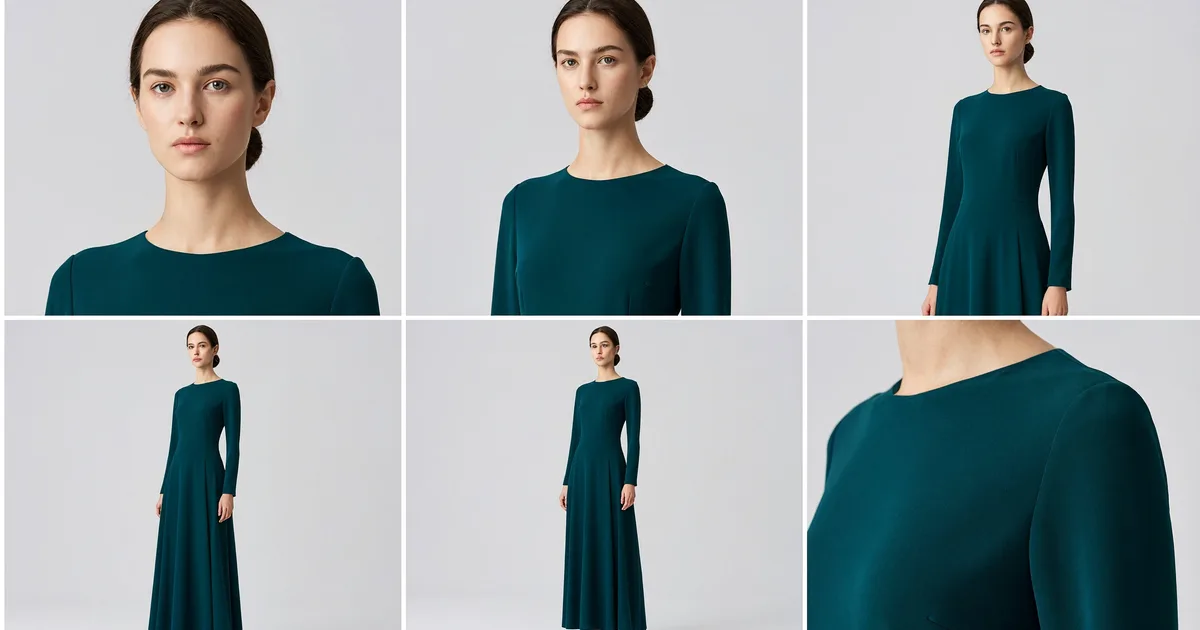
Try it: the finished guide is live at the Dress & Robe Prompting Guide. It is a single page, it loads no third-party scripts, and it works offline once cached.
The brief
Image models are literal about garments in the same way they are literal about hair. "A dress" produces a generic shift. What actually controls the result is a chain of smaller decisions: where the frame cuts, whether the shoulders are covered, how the silhouette falls, and whether the garment is named correctly at all.
The task was to turn a large body of garment and draping knowledge into a lookup that produces usable prompts, without the person doing the prompting needing to be a costume designer.
What the pipeline produced
The build ran as an agentic pipeline: research was gathered, structured into a slot-and-term schema, rendered into reference plates, and assembled into a self-contained document with an embedded search filter and copy-to-clipboard prompt boxes.
The finished guide is organised around a six-slot recipe — frame, garment, coverage, fabric, detail, camera — and covers six camera crops, a six-level shoulder-coverage ladder, six dress silhouettes, and named garments from Japanese, Chinese, Korean and South Asian dress traditions, plus robes and drape layers. The 42 entries carry copy-ready prompt lines, and the framing and coverage entries add a negative-prompt backstop.
The engineering that mattered
Shipping the artifact into a real production site is where the interesting decisions showed up.
The strict content security policy. LiberIT serves with style-src 'self', script-src 'self', and font-src 'self' data:. The guide as originally generated was a single file carrying an inline stylesheet, an inline script, base64-embedded images, and a link to Google Fonts. Every one of those patterns is blocked by that policy, so the page would have rendered as unstyled, inert text. The build was rewritten to emit same-origin parts instead: an external stylesheet, an external script, real image files, and self-hosted webfonts. Nothing on the page touches a third party.
Images identified by what they look like. The seven reference plates were embedded in the source document as re-compressed copies, so they did not match the original files byte for byte. Their order in the document also did not follow the alphabetical order of the filenames: the silhouette plate sat third in the page but was filed seventh on disk. Matching them by filename would have quietly put the wrong plate under the wrong heading. The build instead compares a 16×16 greyscale thumbnail of each embedded image against each source file and takes the closest match, refusing to continue when no candidate is clearly ahead of the runner-up.
One megabyte down to seventy-seven kilobytes. Moving the plates out of base64 data URIs and into WebP files at a sensible width took the HTML payload from 1.0 MB to 77 KB, with the images cached and reused independently. The fonts are served as woff2 files rather than a stylesheet fetched from a font CDN.
Why it is in the lab
Small client projects rarely show their working. This one is a plain example of the kind of work LiberIT does: taking a messy source of truth, giving it a structure that a machine can use, and shipping the result as something a person can actually open, search, and print.
If you have reference material, internal documentation, or a process that needs to become something usable, that is the same shape of problem. See business automation or technology services, or get in touch.
Work with LiberIT
This entry is one of several agentic engineering builds. If you have reference material, internal documentation, or a process that needs to become something people can actually use, the same approach applies to your project.