A garment prompt fails in three predictable places: the frame is too wide, the shoulders
end up bare, and the culture gets muddled. This guide fixes all three — with the exact
wording that holds the crop, covers the shoulders to the neck, and names each
traditional garment properly.
42 illustrated cards7 sections18 traditional garments1-click copy on every prompt
Anatomy of a garment
Eight landmarks. Name the ones that change and the model has nothing left to guess.
Before you prompt
Six slots, one garment prompt
Fill the slots in order. The first two — crop and coverage — are the ones people skip, and they
are the two that decide whether the image is usable.
1 · Framehead and top of shoulders / bust crop / waist-up / full length
6 · Camera85mm portrait, soft studio light, plain background
Weak prompt
beautiful woman in traditional dress, full body
Frame unresolved — model decides full body
No coverage wording — shoulders may end up bare
“Traditional” is not a garment name
No fabric, no pattern, no era
Same idea, filled in
bust crop, hanfu ruqun in pale green silk, high crossed collar, shoulders fully covered, pale floral jacquard, soft studio light, 85mm
Crop and coverage locked
Garment named precisely
Fabric and pattern specified
Camera keeps a series consistent
The one rule that covers most mistakes
Describe the garment, not the absence of skin. “No bare shoulders” leaves the model to invent the neckline. Say what the fabric is doing: high round neckline reaching the base of the neck, fabric covering both shoulders completely, no skin visible above the collarbone. Then add the negative as a backstop, not as the instruction.
Section 1 of 7 · the frame
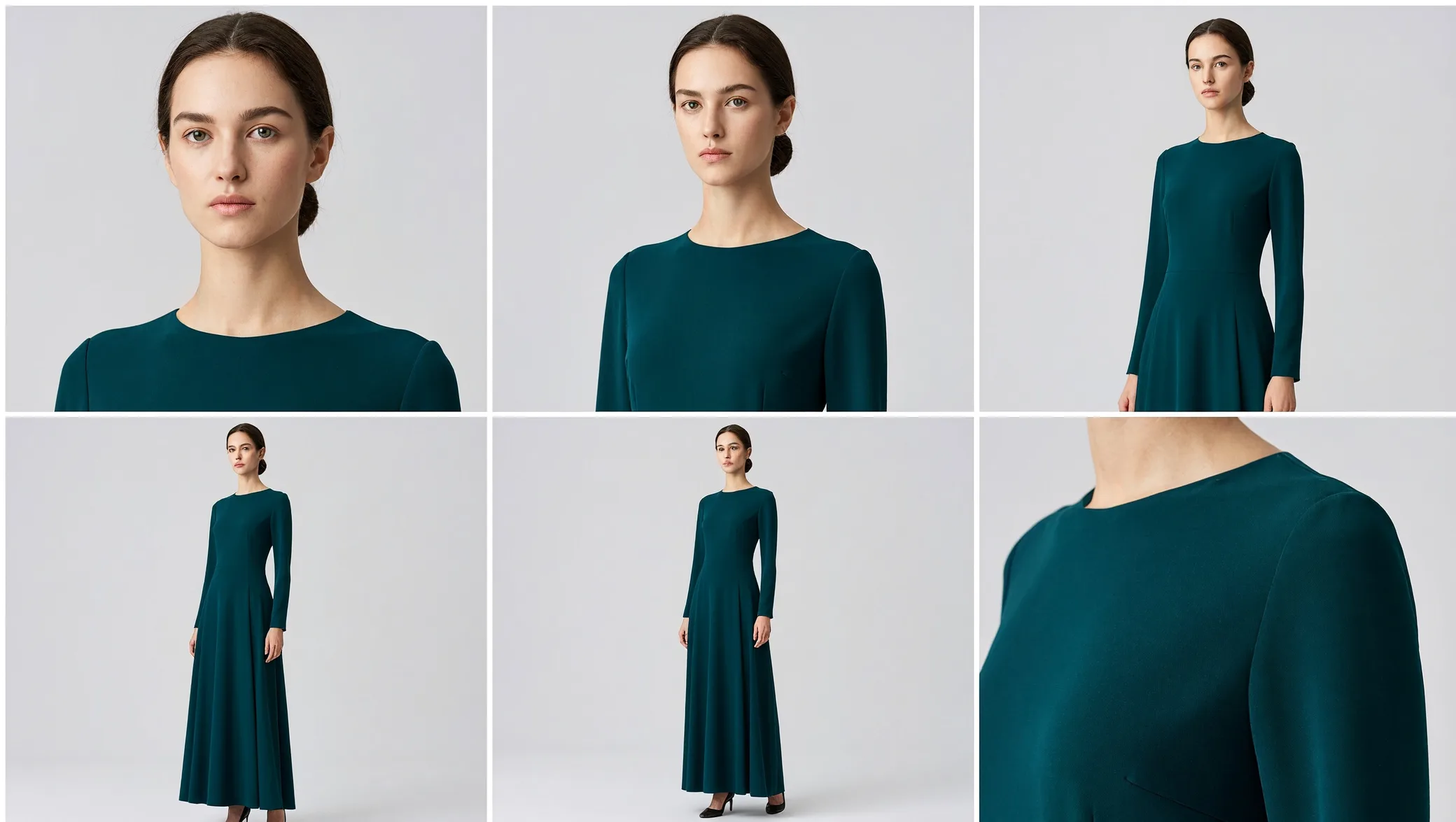
Six crops, named the way a model understands them
Say where the crop line lands on the body — that is the phrase models actually respond to.
“Portrait” alone means anything from a headshot to a full-length shot.
1
2
3
4
5
6
1 head and top of shoulders2 bust crop3 waist-up4 three-quarter5 full length6 neckline detail
Putting it together: a covered-shoulder bust crop
This is the single most useful composite prompt in the guide, because at bust crop the neckline is the subject — every bare-shoulder slip happens right there.
Prompt:bust crop, the frame cuts just below the bust, head neck and shoulders fully in frame, high round neckline reaching the base of the neck, fabric covering both shoulders completely, no skin visible above the collarbone, [garment name] in [fabric] and [colour], soft studio light, 85mm portrait
Negative:bare shoulders, strapless, spaghetti straps, off-shoulder, exposed collarbone, sleeveless, halter neck, open neckline, cropped below the shoulders, full body shot
1
Head and top of shoulders
tight portrait · headshot crop
The frame cuts just below the very top of the shoulders. Chin and forehead are in frame; nothing below the shoulder line. The garment barely appears, so describe the neckline and hair, not the dress.
tight portraitframe cuts below the shoulderschin + forehead in frameno torso
Prompttight head-and-shoulders portrait, the frame cuts just below the top of the shoulders, chin and forehead fully in frame, only the very top of the shoulders visible, high neckline filling the lower frame
Watch: “portrait” alone often renders half-body. Specify where the cut line falls.
2
Bust crop
chest crop · underbust crop
The frame cuts across the chest just below the bust. Head, neck, shoulders and upper chest are visible — the neckline, sleeve cap and drape all read clearly here.
bust cropframe cuts below the bustupper chest in frameneckline visible
Promptbust crop, the frame cuts just below the bust line, head neck and shoulders fully in frame, upper chest visible, [garment] neckline and sleeve clearly visible
Negativewaist, hips, midriff, navel, full body, cropped at the chin
Watch: at this crop the garment detail must be in the prompt, or the model fills the gap with its own idea.
3
Upper-torso crop
chest-to-waist crop
The frame ends at the waist. Adds the bodice, the waistline and the top of the skirt or drape — the point where a garment's construction becomes legible.
frame cuts at the waistbodice visiblewaistline visibletop of skirt
Promptupper-torso crop, the frame cuts exactly at the waist, head to waist in frame, bodice and waistline of the [garment] clearly visible
Negativefull length, skirt below the waist, legs, feet, cropped above the chest
Watch: this is the crop where a wrap or tie closure shows — worth using when the closure is the point.
4
Three-quarter
mid-calf crop · knee crop
The frame cuts at mid-calf or the knee. The full skirt fall is visible but the feet are not — the safe default for full-length traditional dress.
three-quarter shotframe cuts at mid-calfskirt fall visibleno feet
Promptthree-quarter shot, the frame cuts at mid-calf, head to mid-calf in frame, the full fall of the [garment] visible
Negativefeet, shoes, cropped at the knee, extreme close-up, full body zoomed out
Watch: a full-length dress cropped at the calf looks accidental; name the cut point every time.
5
Full length
head-to-toe · full body
Head to toe, hem and feet in frame. Use this when the whole garment story matters — the drape of a sari pallu, the width of a boubou, the length of a qipao.
full-length shothead to toehem visiblefeet in frame
Promptfull-length shot, head to toe, the hem and feet of the [garment] fully in frame, floor-length [garment], soft studio light, 85mm
Negativecropped at the knee, cropped at the waist, missing feet, tight crop
Watch: full-length needs vertical room — say vertical composition, full figure centred or feet get cropped anyway.
6
Neckline detail
collar close-up · fabric detail shot
A tight close-up of the neck, collar and shoulder seam. This is where the coverage statement is proven — use it as the companion shot to a bust crop.
close-upneckline detailcollar and shoulder seamfabric texture
Prompttight close-up of the neckline and shoulder area, high collar reaching the base of the neck, fabric covering both shoulders completely, no skin visible above the collarbone, macro detail of the weave
Negativeface, full body, wide shot, bare shoulder, collarbone, neckline gap
Watch: say no skin visible above the collarbone here — it is the most direct coverage instruction in the guide.
Section 2 of 7 · shoulder coverage
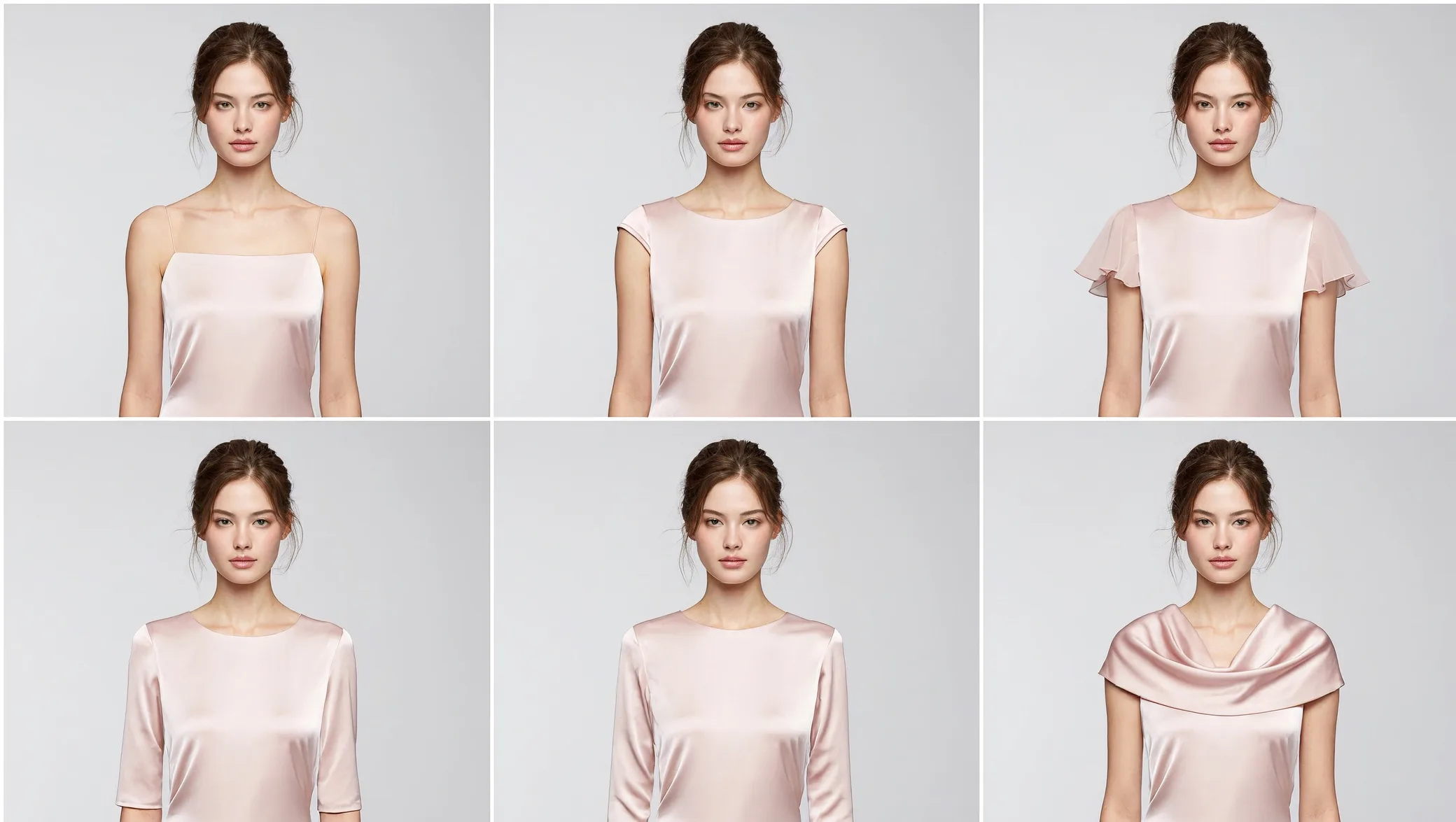
The coverage ladder
Six levels from bare to fully covered, and the exact words that hold each one. Level 5 and 6 are
the ones that keep a look modest and appropriate without saying anything negative.
L1Bare shoulders — strappy or strapless, collarbone exposed
L2Cap sleeve — a sliver of shoulder still visible
L3Flutter sleeve — top of the shoulder covered
L4Elbow sleeve, open neckline — shoulders covered, collarbone still bare
L5High neckline + full sleeve — collarbone covered, fabric to the base of the neck
L6Drape over the shoulders — shawl, dupatta or cape layered over a covered neckline
1
2
3
4
5
6
1 bare shoulders2 cap sleeve3 flutter sleeve4 elbow sleeve, open neck5 high neckline + long sleeve6 draped, fully covered
Level 5 and 6 wording — the part to reuse
Level 5 (fabric to the neck):high round neckline reaching the base of the neck, shoulders fully covered by fabric, no skin visible above the collarbone, long sleeves covering the arms completely
Level 6 (drape over the top):high covered neckline with a soft shawl draped over both shoulders, the drape rising to the base of the neck, fabric layered over the shoulders and upper arms
Negative backstop for both:bare shoulders, strapless, spaghetti straps, off-shoulder, exposed collarbone, sleeveless, halter neck, low neckline, open neckline, cleavage
1
Level 1 · Bare shoulders
strappy · strapless · sleeveless
Shoulders and collarbone fully exposed. Listed here so you can name it when you need the opposite.
Promptsleeveless dress with thin straps, shoulders and collarbone bare, [fabric] and [colour], [crop], soft studio light
Watch: if this is the opposite of what you want, name it in the negative prompt rather than hoping the model reads the mood.
2
Level 2 · Cap sleeve
tiny sleeve cap
A sliver of fabric sits on the shoulder edge. Barely different from L1 visually — models often under-render it.
cap sleevetiny sleeveshoulder edge
Promptdress with small cap sleeves just covering the edge of the shoulders, round neckline, collarbone visible
Watch: add small and just or the model draws full sleeves.
3
Level 3 · Flutter sleeve
flounce sleeve · angel sleeve
A short loose sleeve that rests on the top of the shoulder — the point where shoulders start to read as covered.
flutter sleeveloose short sleeverests on the shoulder
Promptdress with short loose flutter sleeves resting over the top of the shoulders, soft flounced edge, round neckline
Watch: still shows the collarbone — not enough if the look must be fully covered.
4
Level 4 · Sleeve, open neckline
long sleeve · round neck
Shoulders and arms fully covered, but the neckline still opens above the collarbone. The most common everyday look — and the one that drifts into L3 if you do not say the sleeve is fitted.
Fabric rises to the base of the neck, collarbone fully covered, arms covered by long sleeves. This is the workhorse level for modest and traditional dressing.
high round necklinebase of the neckno skin above collarbonelong sleeves
Prompthigh round neckline reaching the base of the neck, shoulders fully covered by fabric, no skin visible above the collarbone, long sleeves covering the arms completely, [garment] in [fabric] and [colour], [crop], soft studio light
Watch: “high neckline” alone can still dip at the front — add reaching the base of the neck and no skin above the collarbone.
6
Level 6 · Draped over the shoulders
shawl · dupatta · stole · cowl drape
A covered neckline with a soft layer laid over both shoulders — a shawl, dupatta, stole or cowl. This is what traditional dress actually does, and it is the safest level of all.
shawl over shouldersdupatta drapecowl necklinecovers upper arms
Prompthigh covered neckline with a soft shawl draped over both shoulders, the drape rising to the base of the neck, fabric layered over the shoulders and upper arms, falling to the elbows, [fabric] and [colour]
Negativebare shoulders, exposed collarbone, sleeveless, strapless, shawl slipping off one shoulder
Watch: add draped over both shoulders — otherwise one shoulder often ends up bare.
Section 3 of 7 · silhouette
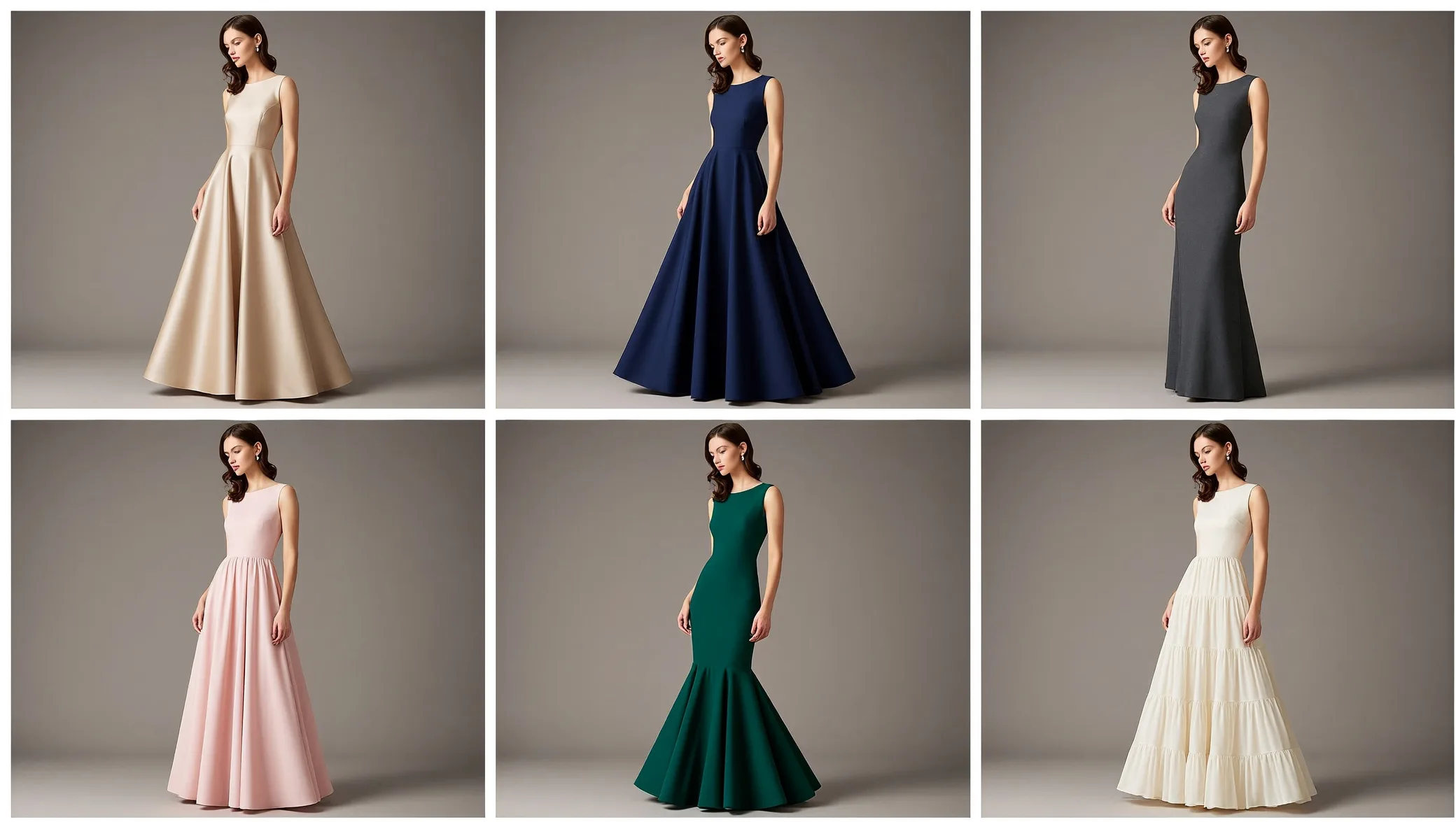
Dress shapes you can name out loud
Silhouette is the shape the garment makes on the body. Name it and the model stops guessing —
and you can mix a silhouette with any of the traditional garments in the next four sections.
Fitted at the bodice and flaring gradually from the waist, so the skirt falls in a straight cone. The most forgiving shape for traditional lengths.
A-linefitted bodiceflares from the waistcone-shaped skirt
PromptA-line gown, fitted bodice flaring gradually from the waist into a straight cone skirt, floor length, [fabric], [crop]
Watch: A-line is a gradual flare — fit-and-flare has a sharp seam and a much wider skirt.
2
Fit-and-flare
fit & flare · fitted waist
Fitted through the bodice and hips, then a defined seam at the waist and a wide swinging skirt.
fit-and-flarefitted through the hipsdefined waist seamfull skirt
Promptfit-and-flare dress, fitted through the bodice and hips, sharp seam at the waist, full circular skirt swinging away from the body
Watch: name the sharp seam — without it the model renders a soft A-line.
3
Sheath / column
column dress · slip dress · body-skimming
Straight and narrow, skimming the body from shoulder to hem. The closest thing to a modern qipao in Western dress language.
sheathcolumnstraight and narrowskims the body
Promptslim sheath column dress, straight narrow cut skimming the body from shoulder to hem, no flare, clean minimal silhouette
Watch: pair with no flare — the default is a flared skirt.
4
Empire waist
raised waist · high-waisted seam
The seam sits just under the bust and the skirt flows from there — a long, high-waisted line. Common in Indian and Chinese traditional forms.
empire waistseam under the bustraised waistlineflowing skirt
Promptempire-waist dress, seam sitting just under the bust, long flowing skirt falling from the raised waist, [fabric]
Watch: say just under the bust — otherwise the seam lands at the natural waist.
5
Mermaid / trumpet
fishtail gown · fitted then flared
Fitted through the body and flaring dramatically from the knees down. High maintenance on a real body, so state it plainly.
mermaidfitted to the kneedramatic flarefishtail
Promptmermaid gown, fitted through the torso hips and thighs, flaring dramatically from the knees down in a wide trumpet sweep
Watch: without from the knees down the flare starts at the hip and you get an A-line.
6
Tiered
tiered skirt · ruffle tiers · banded
Several horizontal tiers of gathered fabric from the waist down, each one flaring over the last. Reads volume and movement.
tieredhorizontal tiersgatheredruffled volume
Prompttiered dress, several horizontal tiers of gathered fabric from the waist down, each tier flaring over the one below, soft full volume
Watch: say horizontal — the default drifts to diagonal or spiral draping.
Section 4 of 7 · japanese
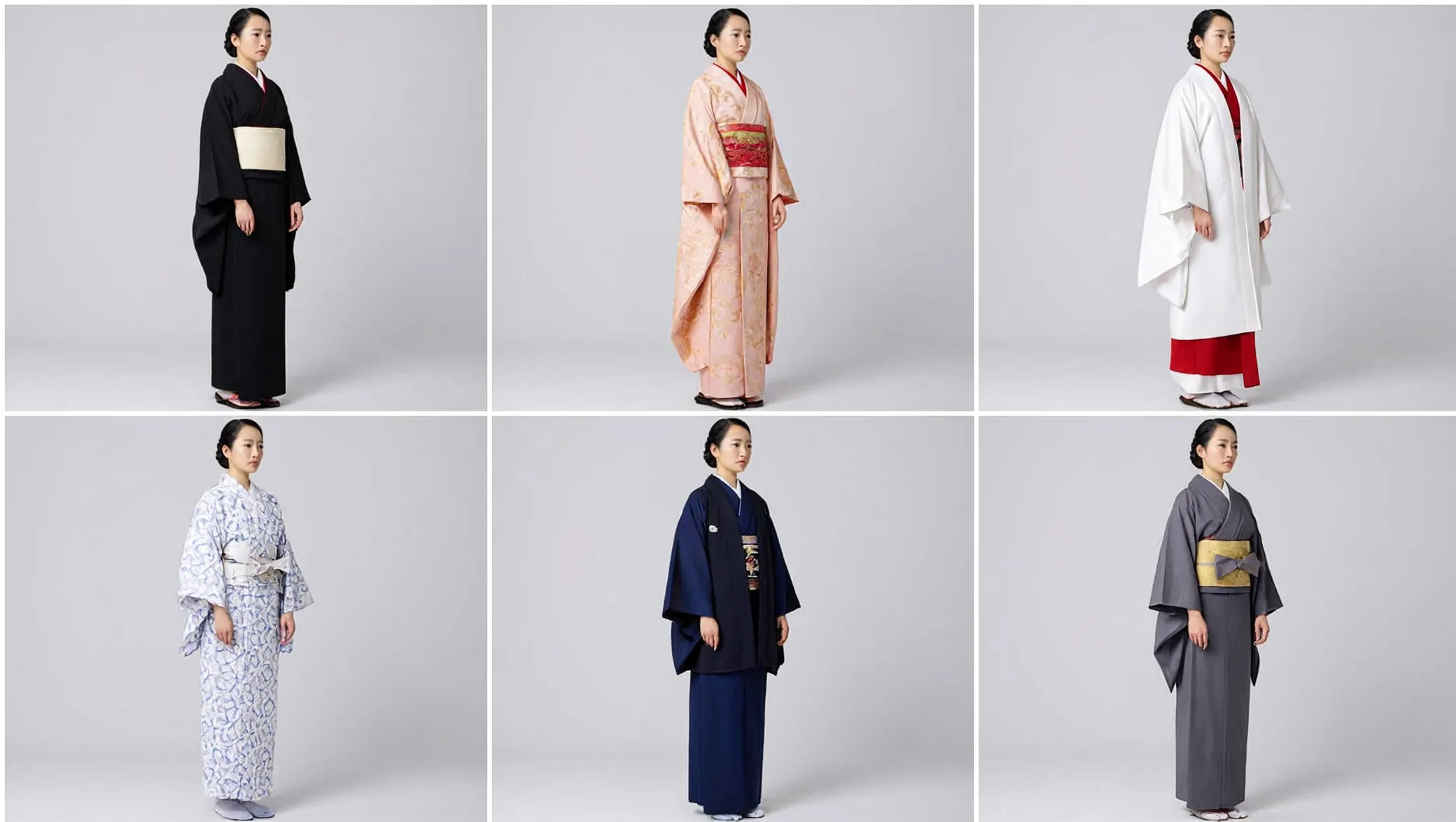
The kimono family
A kimono is not one dress. The name changes with formality, sleeve length and occasion — and the
obi is what separates one kimono from another at a glance.
The most formal everyday kimono: solid black, almost no pattern, long straight sleeves, worn with a wide flat obi. A black tomesode is the correct choice for formal occasions and funerals.
Promptformal black tomesode kimono, solid black silk with no pattern, straight ankle-length sleeves, wide cream obi tied flat, white collar at the neck, shoulders fully covered
Watch: a black kimono is a formal and funerary garment — do not dress it for a beach or a party scene.
2
Furisode
long-sleeve kimono · party kimono
The sleeves hang in long swinging arcs to the knee or floor. Worn by unmarried women at coming-of-age ceremonies and formal celebrations.
furisodevery long sleevesformalfestival
Promptfurisode kimono with very long swinging sleeves reaching the knees, pale pink silk with gold patterning, red collar, formal obi, hair styled up with a kanzashi ornament
Watch: the sleeve length is the whole point — say very long sleeves reaching the knees or it renders as a standard kimono.
3
Uchikake
over-kimono · wedding robe · shiromuku
A white over-kimono worn over a coloured under-kimono, with wide sleeves and a long train. The bridal layer; a white shiromuku is its simplest, all-white form.
uchikakewhitelayered over-kimonowide sleevestrain
Promptwhite uchikake over-kimono layered over a red and white under-kimono, wide sleeves, floor-length train, formal wedding attire, obi tied at the back
Watch: the under-kimono colour is the tell — say layered over so it does not come out as a plain white robe.
4
Yukata
casual kimono · cotton robe
Unlined cotton, worn untucked with the hem just below the knee, usually with a narrow obi tied in a bow. Summer, onsen and casual wear.
yukatacasualcottonuntuckedshort
Promptlight cotton yukata with a simple indigo pattern, worn untucked with the hem below the knee, narrow obi tied in a bow, summer casual wear, zori sandals
Watch: the untucked knee-length hem is what separates a yukata from a kimono — state it.
5
Kimono with haori
haori jacket · over-kimono layering
A kimono under an open haori — a stiff jacket with a wide collar and a family crest on the chest. The classic layering for a formal kimono.
haoriwide collarcrestlayeredopen front
Promptplain navy kimono worn under an open haori jacket with a wide stiff collar and a small crest on the chest, layered over, shoulders fully covered
Watch: say open, layered over and name the collar width — a haori is stiff and squared, not a soft cardigan.
6
Casual kimono with hanhaba obi
half-width obi · komon kimono
A light komon kimono with a narrow half-width obi tied in a flat bow — the everyday, daytime version of the kimono.
hanhaba obihalf-widthflat bowkomondaytime
Promptcasual komon kimono in grey with a narrow half-width obi tied in a flat bow at the front, everyday daytime wear, tabi socks
Watch: a front bow is the hanhaba signal; a wide back bow reads as a formal maru obi.
Getting a kimono right, beyond the name
Wrap direction: the left panel crosses over the right, so the left side sits on top. Say left panel over right if a model gets it wrong — and note that the reverse is used in funerary dress, so do not add it to a casual scene.
Silhouette: a kimono is straight and unstructured — no waist seam, no flare, no belt line. Say straight unstructured cut with no waist seam if the model gives you a fitted dress.
The collar: the white undercollar shows at the neck. white collar visible at the neckline is a one-word fix for a kimono that looks like a bathrobe.
Section 5 of 7 · chinese & east asian
Hanfu, qipao and neighbours
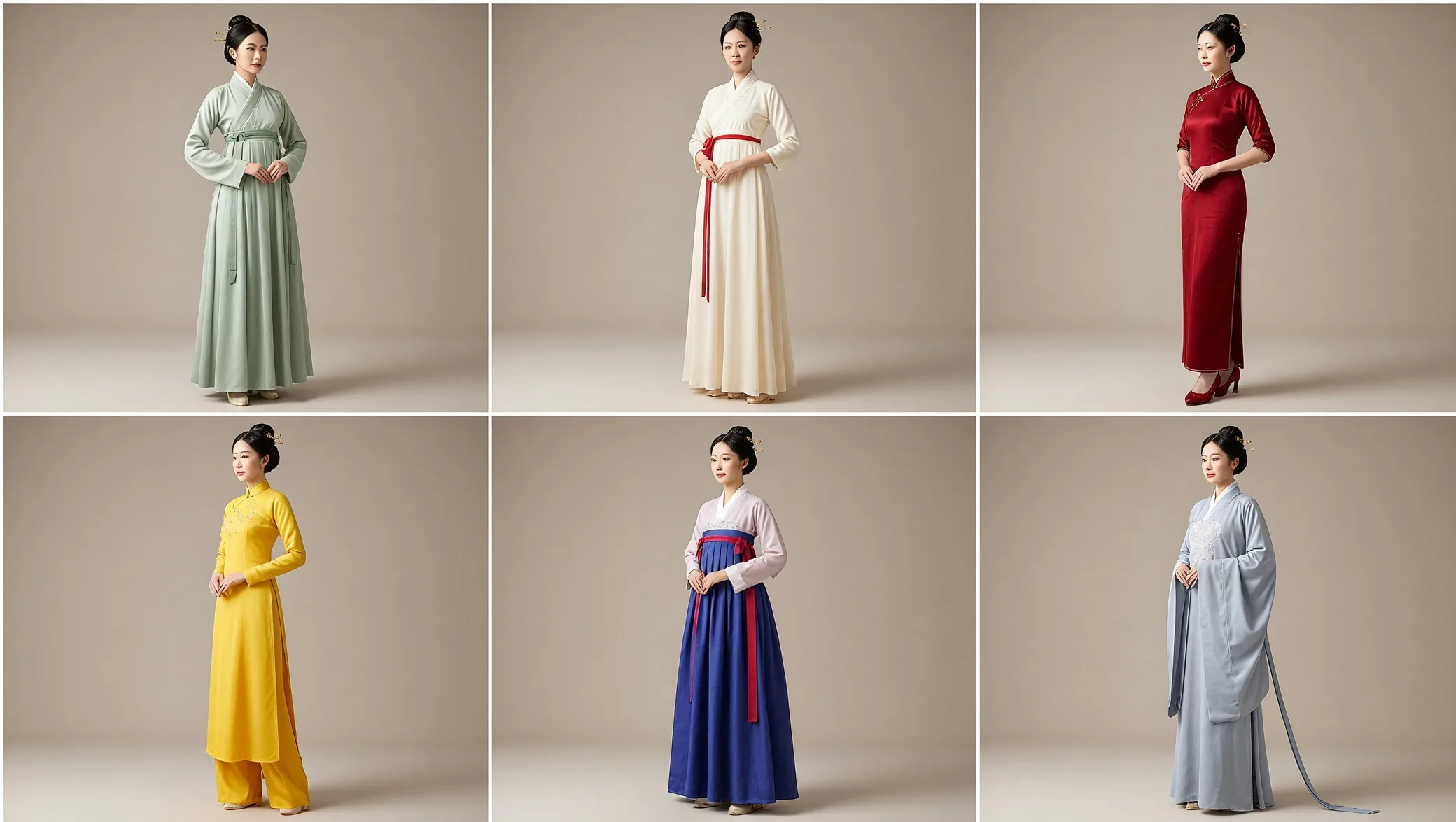
Hanfu and the qipao are two different worlds: hanfu is a family of historical Chinese dress with
wide sleeves and cross collars, the qipao is a modern fitted Chinese dress. Mixing them is the
most common accuracy error.
1
2
3
4
5
6
1 hanfu ruqun2 hanfu aoqun3 qipao / cheongsam4 Vietnamese ao dai5 Korean hanbok6 hanfu, wide sleeves
1
Hanfu ruqun
jiaoling youren · crossed-collar top + skirt
A crossed-collar top with wide sleeves worn over a high-waisted pleated skirt. The most recognisable hanfu silhouette.
hanfuruquncrossed collarpleated skirtwide sleeves
Prompthanfu ruqun, crossed-collar top with wide sleeves over a high-waisted pleated skirt, pale green silk, right side overlapping left, sash tied at the waist, shoulders fully covered
Watch: say crossed collar, right over left — the model usually reverses it.
2
Hanfu aoqun
poqun · wrap top + long open skirt
A wrap-style top over a long open skirt, fastened with a trailing sash. Softer and more fluid than the ruqun.
aoqunpoqunwrap toplong open skirttrailing sash
Prompthanfu aoqun, wrap-style top over a long open skirt, ivory silk with a red silk sash trailing from the waist, wide draped sleeves, floor length
Watch: the open skirt over an under-layer is the defining detail — say open overskirt.
3
Qipao / cheongsam
modern chinese fitted dress · mandarin collar
A fitted, body-skimming dress with a mandarin collar, side slits and pankou frog buttons. Modern Chinese dress, not hanfu.
Promptqipao cheongsam, fitted body-skimming dress in deep red silk, mandarin collar, pankou frog closures down the side, high side slit to the thigh, floor length
Watch: a qipao is fitted and modern. If you want loose historical hanfu, ask for hanfu, not qipao.
4
Vietnamese áo dài
ao dai · long tunic over trousers
A long, fitted tunic with a high collar worn over wide-leg trousers, with side panels that open over the trousers and often a small chest pocket.
PromptVietnamese ao dai, long fitted tunic with a high collar over wide-leg trousers, side panels opening over the trousers, bright yellow silk, floor length
Watch: the trousers are essential — without them it renders as a plain dress.
5
Korean hanbok
jeogori · chima · goreum ribbon
A short jacket over a full, voluminous skirt, with a long ribbon tied in a bow at the chest. The jacket sits above the waist; the skirt falls to the ankles.
PromptKorean hanbok, short jeogori jacket over a full voluminous ankle-length chima skirt, long goreum ribbon tied in a bow at the chest, jewel-toned silk, skirt falling in soft gathers
Watch: say short jacket — the jacket length and the skirt volume are what make it read as hanbok.
6
Hanfu with water sleeves
panguan · wide flowing sleeves
Hanfu with very long, wide, open sleeves that hang like fabric panels, with a long sash trailing behind. The most dramatic hanfu form.
water sleevesvery widefloor-lengthlong sashflowing
Prompthanfu with very long wide open water sleeves hanging as fabric panels, pale blue-grey silk, long trailing sash, floor length, wide sleeves reaching the floor
Watch: specify the sleeve width and drop; otherwise it renders as a standard wide-sleeve hanfu.
Hanfu ≠ qipao — keep them apart
Hanfu is loose, layered and historical: cross collars, wide sleeves, high waist, no body shaping. The qipao is modern, body-hugging and buttoned to the side. If a prompt mixes them you get a fitted dress with huge sleeves — a costume that exists nowhere.
Quick discriminator to add to the prompt: loose layered historical hanfu, no buttons down the front or modern fitted cheongsam, side closure.
Section 6 of 7 · other regions
Traditional dress beyond Asia
Six more traditions with their own structural logic. Naming the garment gets you the drape, the
drape is the difference between a costume and a real garment.
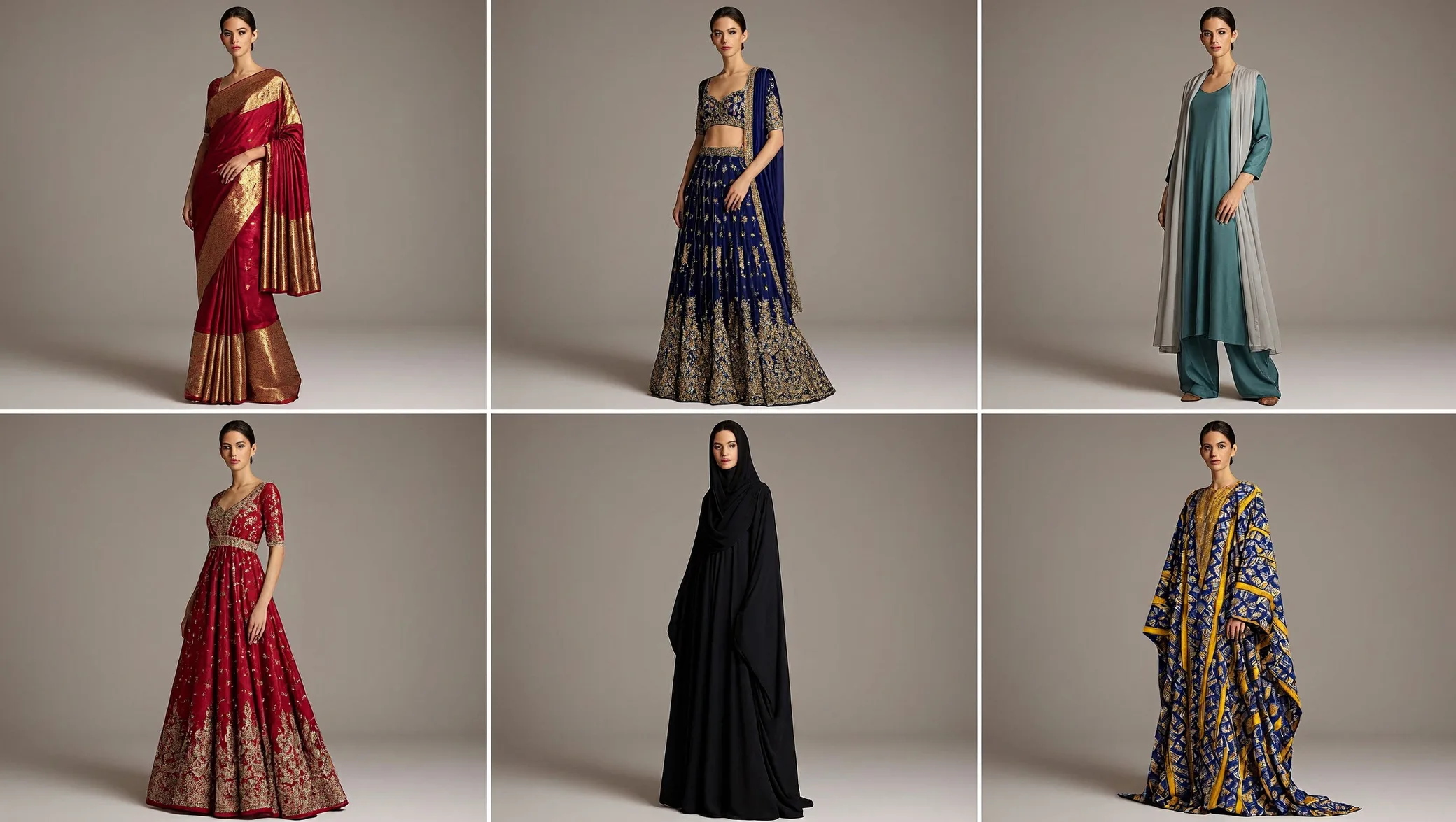
An unstitched length of fabric wound around the body: a pleated section at the front, a fitted blouse, and the pallu — the decorated end — draped over the shoulder.
saripallu over shoulderpleatedfitted blouseunstitched
PromptIndian sari, deep red silk with a gold brocade pallu draped over the left shoulder, pleated front falling to the floor, short fitted blouse, heavy gold border
Watch: say unstitched draped fabric and name the pallu — a sari is not a sewn dress.
2
Lehenga choli
ghagra choli · Indian
A heavily embroidered floor-length skirt with a cropped choli blouse and a dupatta. Wedding and festival dress — and the crop is intentional.
lehengacropped choliembroidereddupattafull skirt
PromptIndian lehenga choli, heavily embroidered floor-length skirt with a cropped choli blouse, sheer dupatta draped over the shoulder, gold zari work, festive
Watch: the crop is the point — if you want coverage, use the salwar kameez or add a dupatta over the midriff.
3
Salwar kameez
salwar suit · churidar · Punjabi
A long tunic (kameez) over loose trousers (salwar or churidar), with a dupatta draped over the shoulders. The everyday modest option, and the easiest traditional look to keep covered.
salwar kameezlong tunicloose trousersdupatta on shouldersfull coverage
Promptsalwar kameez, long embroidered tunic falling below the knee over loose salwar trousers, sheer dupatta draped over both shoulders, fabric fully covering the arms and chest, [colour]
Watch:dupatta draped over both shoulders is what lifts this to level 6 coverage — say it explicitly.
4
Anarkali
anarkali suit · Indian
A fitted bodice opening into a heavily flared, embroidered floor-length gown — the same family as the lehenga, but a single flowing piece.
PromptIndian anarkali, fitted embroidered bodice flowing into a heavily flared floor-length gown, long sleeves, gold zari motifs, churidar trousers visible at the hem
Watch: anarkali is the gown; salwar kameez is the tunic-and-trouser. They get confused constantly.
5
Abaya with headscarf
jilbab · hijab · long loose gown
A long, loose, flowing gown with wide sleeves, worn over a headscarf that covers the hair and neck. Everything is covered, which makes the silhouette the main event.
Promptlong black abaya, loose flowing gown with wide sleeves and a floor-length fall, matching headscarf covering the hair and neck, simple matte fabric, no jewellery
Watch: the headscarf covering the neck keeps the whole look consistent — mention it or the neckline opens up.
6
Boubou / agbada
West African grand boubou · flowing robe
A very wide, flowing robe with wide sleeves worn over a matching tunic, often in bold printed or embroidered fabric. The volume is the defining feature.
PromptWest African boubou agbada, extremely wide flowing robe with very wide sleeves over a matching tunic, floor length, bold blue and gold print, dramatic volume
Watch: say extremely wide — a merely loose robe loses the whole silhouette.
Section 7 of 7 · robes & drape
Robes, capes and layered drape
A robe is defined by how it closes and how it falls. If you name the closure — sash, belt, tie,
frogs, hooks — the rest of the garment follows.
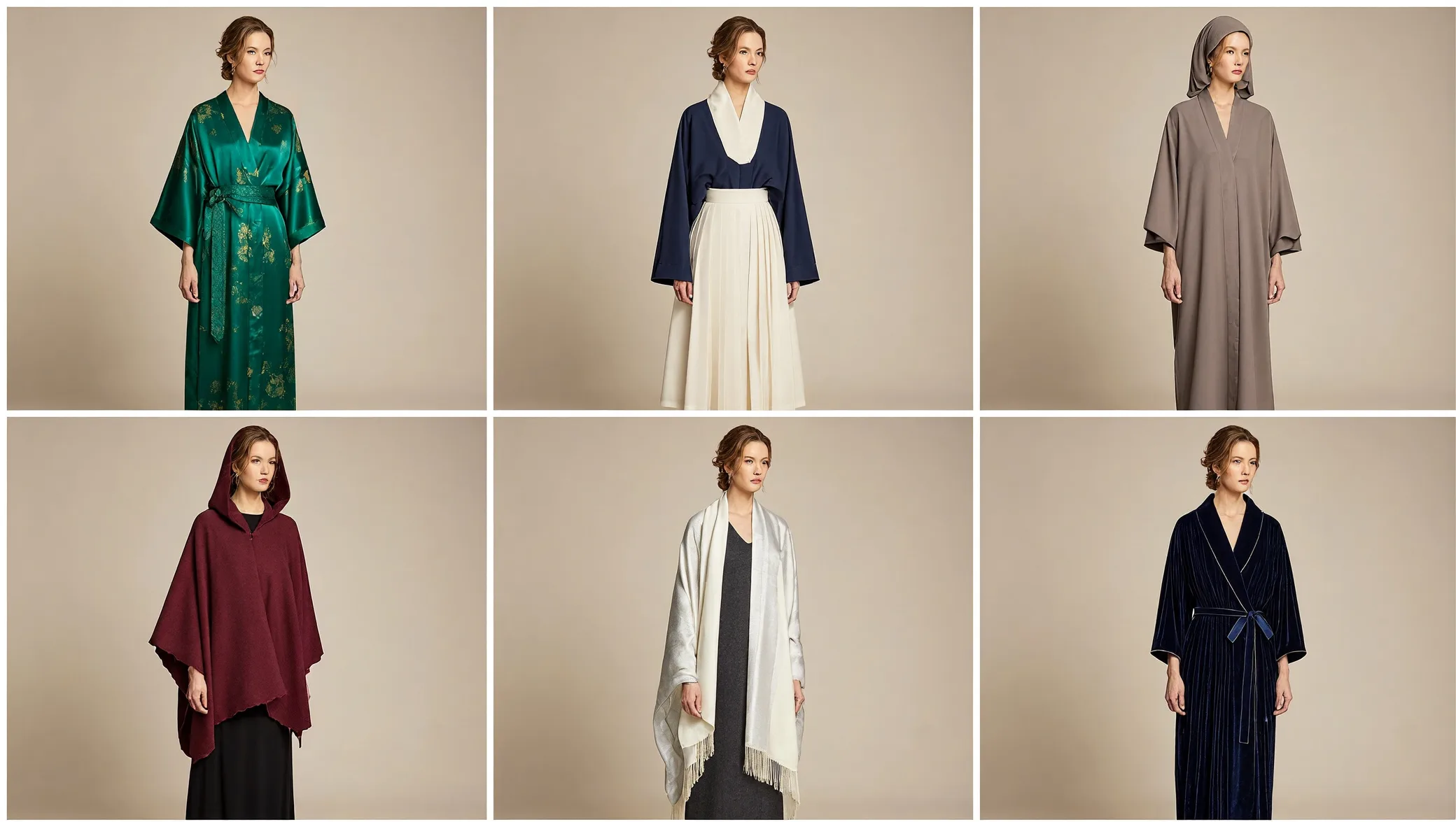
A wide-sleeved robe closed with a sash tied at the waist. The universal robe shape: overlapping front, wide sleeves, belt defining the waist.
wide sleevesoverlapping fronttied at the waist
Promptemerald silk robe with wide sleeves and an overlapping front, matching sash belt tied at the waist, subtle gold pattern, shoulders fully covered by the robe
Watch: name the overlap and the sash — without them the model gives a coat.
2
Haori-style jacket robe
short jacket robe · open front
A short open jacket with a wide, stiff, contrasting collar worn over a pleated skirt. A robe length but a jacket construction.
short jacketwide contrasting collaropen frontlayered over a skirt
Promptshort haori-style jacket robe with a wide stiff contrasting collar, worn open over a pleated skirt, mid-thigh length, layered, shoulders covered by the jacket
Watch: say worn open and layered over — otherwise it closes into a coat.
3
Prayer robe with head covering
jilbab · full-length modest robe
A loose, flowing full-length robe with a matching head covering that conceals the hair and neck. The most fully covered garment on this page.
Promptfull-length prayer robe in matte dark fabric, loose flowing silhouette, matching head covering concealing the hair and neck, no visible jewellery, simple and reverent
Watch: say concealing the hair and neck — “with a scarf” alone leaves the neck visible.
4
Hooded poncho / cape
cape over a dress · ruana
A single wide panel of fabric with a hood or neck opening, draped over a plain dress. The easiest level-6 coverage layer there is.
ponchocapehoodeddraped over a dressone panel
Prompthooded poncho cape in deep wool over a simple plain black dress, one wide panel of fabric falling from the shoulders to the knee, both shoulders fully covered, soft matte texture
Watch: state that the dress underneath is plain — the model adds a second pattern otherwise.
5
Pashmina shawl drape
stole · wrap · shawl over a dress
A long, fine shawl wrapped around the shoulders over a plain dress, the fabric falling to the knees. Pure level-6 coverage in one layer.
pashminawrapped over both shouldersfalls to the kneesplain dress underneath
Promptlong pashmina shawl wrapped over both shoulders on a plain dress, soft hand-embroidered border, the fabric falling to the knees, shoulders and upper arms completely covered
Watch:wrapped over both shoulders and completely covered — the shawl slipping to one side is the default.
6
Dressing gown
bedrobe · shawl-collar gown
A long, softly pleated gown with a shawl collar and a tie belt at the waist. Looser and more relaxed than a formal robe.
shawl collartie beltsoft pleatslongrelaxed
Promptlong dressing gown with a shawl collar and a tie belt at the waist, soft pleated fabric falling to the ankles, relaxed elegant drape, covered shoulders
Watch:shawl collar is the term that gives the rolled, draped neckline — a plain round collar gives a different garment.
Reference · vocabulary
Words worth having in your pocket
These are the terms a stylist or a costume historian would use. Swap them in for the vague
versions and the image gets more precise immediately.
Framing cheat sheet
Crop
Say this
Negative backstop
Head + top of shoulders
tight portrait, frame cuts just below the top of the shoulders
torso, chest, waist, full body
Bust
bust crop, frame cuts just below the bust line
waist, hips, midriff
Upper torso
upper-torso crop, frame cuts exactly at the waist
legs, skirt below the waist
Three-quarter
three-quarter shot, frame cuts at mid-calf
feet, cropped at the knee
Full length
full-length shot, head to toe, hem and feet in frame
cropped at the knee, missing feet
Detail
tight close-up of the neckline and shoulder area
face, wide shot
Coverage cheat sheet
Level
Say this
Negative backstop
Shoulders covered
fabric covering both shoulders completely, long sleeves covering the arms
sleeveless, strapless, bare shoulders
Covered to the neck
high neckline reaching the base of the neck, no skin visible above the collarbone
open neckline, exposed collarbone, cleavage
Fully covered
high covered neckline with a shawl draped over both shoulders
shawl slipping off one shoulder
Head covered
matching head covering concealing the hair and neck
visible hair, bare neck
Legs covered
floor-length, hem reaching the floor
cropped at the knee, bare legs
Necklines
Crew / roundhigh, close to the base of the neck
Mock necktaller, covers the throat
Funnel necktall, dramatic, open at the front
Boat neckwide, runs past the shoulder point
Mandarinshort standing collar, buttoned front
Cowldraped, folded neckline
Portage / portraitrounded, open at the front
Notched collarlapels meeting at the centre
Sleeves
Captiny, sits on the shoulder point
Flutter / flounceshort, loose, ruffled
Bellflares out toward the wrist
Bishop / puffgathers into a fitted cuff
Kimono sleevewide, integral with the body
Batwing / dolmandeep armhole, one cut with the body
Set-insleeve sewn in at a visible seam
Water sleevevery wide, open, hanfu and opera style
Fabrics
Silkfluid, lustrous, takes a drape
Brocadepattern woven in, often gold thread
Jacquardwoven pattern, repeats with the fabric
Chiffonsheer, floaty, layers well
Organzastiff sheer, crisp volume
Cotton voilelight, matte, everyday
Velvetsoft pile, absorbs light
Wool crepematte, drapes in soft folds
Construction & closure
Bias cutcut on the diagonal, gives stretch and fluid fall
Box pleatdeep, flat pleat
Sunburst pleatpleats fanning from a point
Wrapclosed by overlapping and belting
Drapegathered or folded fabric, no seams
Pankou / frogChinese knotted button closure
Togglebar-and-loop closure, common on duffle coats
Tie belta sash or belt rather than a sewn waistband
Getting traditional dress respectfully right
Name the garment, the region and the occasion together, and keep them consistent: formal black tomesode kimono for a funeral, not black kimono at a beach party. Three habits keep images on the right side of respect:
• Keep formality tied to occasion — a black tomesode is a formal and funerary garment; a yukata is not.
• Keep one tradition per image — a kimono obi with a hanfu robe is a costume, not a culture.
• Keep period and modern apart — hanfu is loose and historical, the qipao is fitted and modern; a salwar kameez is not an anarkali.